Binary option scams are rarely obvious when a trader first encounters them. The websites can look professional, account balances update in real time, customer support replies quickly and social media channels may contain hundreds of screenshots showing withdrawals and profitable trades. Some platforms even allow an initial withdrawal. That first payment can be one of the most effective parts of the scam because it convinces the customer that a larger deposit is safe.
The real test normally arrives later, when the trader wants a meaningful amount of money back.
Regulators have received complaints involving binary options platforms that refused withdrawals, failed to credit customer accounts, collected personal information for improper purposes and manipulated trading software to produce losing outcomes. The US Commodity Futures Trading Commission and Securities and Exchange Commission have warned about all of these practices. The UK Financial Conduct Authority gives an even simpler warning to British consumers: binary options have been banned for UK retail customers since 2019, so a company offering them to UK consumers is probably unauthorized or fraudulent.
Avoiding binary option scams therefore starts before looking at payout percentages, expiry times or trading strategies. The first question should be whether the business taking the money can be independently identified and whether it is legally permitted to offer the product where the customer lives.
A polished platform proves very little. A licence that cannot be confirmed independently proves even less.
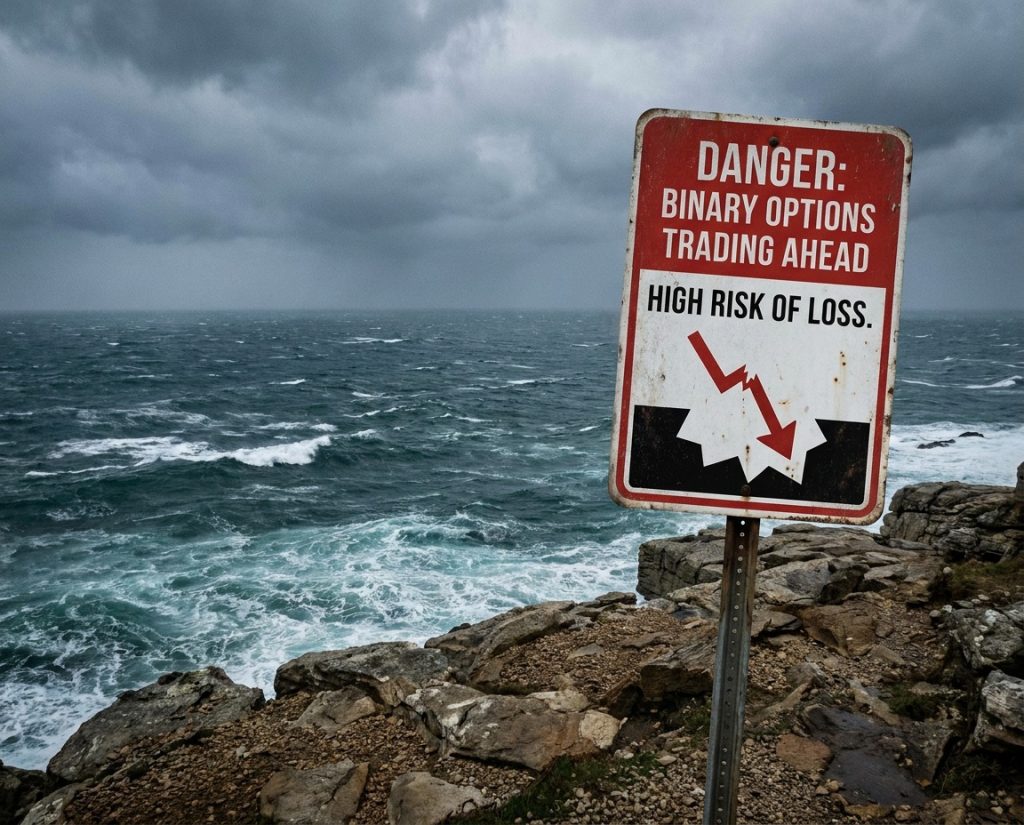
Why Binary Options Attract So Many Scams
Binary options are unusually convenient for dishonest operators because the product already has an all or nothing result. A legitimate binary contract settles according to whether a stated condition is true at expiry. A trader might predict that EUR/USD will finish above a particular level five minutes from now. If correct, the contract pays its stated return. If wrong, the stake can be lost.
The binary nature makes it difficult for an inexperienced customer to distinguish ordinary losses from manipulated ones. If a conventional share account repeatedly displayed trades at prices that never existed in the underlying market, the discrepancy may eventually be obvious. A five minute binary option missing its strike by a tiny amount can feel plausible even if the platform has interfered with its displayed pricing or expiry calculation.
US regulators have specifically received allegations of software manipulation in which platforms distorted prices or extended expiry periods until what had been a winning contract became a loss. They have also received complaints involving refusal to reimburse customer funds and misuse of identity information.
The business model also makes fake profits easy to manufacture. A fraudulent website does not necessarily need to execute any trades. It can display whatever account balance its database has been programmed to show. A customer deposits $500 and sees $820 after several apparent successful trades. Nothing requires that $820 to exist outside the screen.
This is why a screenshot of a profitable account proves almost nothing.
A legitimate financial balance represents an enforceable claim against an identifiable company operating under defined legal terms. A fake brokerage dashboard is just a number stored in a database. The difference only becomes apparent when the customer asks for the money.
The Most Important Scam Check Happens Before You Deposit
The safest point in a binary options scam is before any money has been sent.
Once funds have moved to an offshore company, cryptocurrency wallet or unrelated payment recipient, recovery becomes considerably harder. Traders should therefore treat regulatory and corporate verification as part of opening the account rather than something to investigate after a withdrawal has failed.
The first check is the exact legal company taking the deposit. A trading brand is not enough. The trader should be able to establish a full corporate name, registration or licence number, regulator, registered office and the terms identifying which company owes the customer money.
The exact domain matters too.
Scammers regularly use names resembling legitimate financial companies. A fraudulent website can copy the logo, regulatory number and company address of an authorised business while using a slightly different domain or telephone number. The Malta Financial Services Authority has even published warnings involving clone websites that copied details belonging to genuine Deriv entities.
The correct procedure is therefore to start with the regulator rather than with the broker’s footer. If the website says it is regulated, open the regulator’s own register independently and search for the company. Check that the domain, legal name and contact information match.
A screenshot of a licence sent over Telegram or WhatsApp is not enough. Neither is a certificate uploaded to the broker’s own website.
A licence needs to exist where the regulator says it exists.
Guaranteed Profits Are a Reason to Leave, Not Investigate Further
A binary options promoter promising guaranteed profits has already provided useful information: the offer should be avoided.
No legitimate trading business can guarantee that a customer will profit from short term financial market predictions. The underlying markets move unpredictably, and binary contracts add the additional problem that the payout on a winning contract is frequently smaller than the amount lost on an unsuccessful one.
A common scam pitch avoids using the word guaranteed and instead makes the claim slightly softer. The promoter may say their artificial intelligence system produces a 90% win rate, their copy trading account has never suffered a losing month or an expert trader can reliably produce 5% every day.
The wording sounds more sophisticated. The problem is unchanged.
Scammers also use social proof to make these claims feel credible. WhatsApp and Telegram groups may appear full of customers posting successful withdrawals. Social media accounts show screenshots of profitable dashboards and mobile money receipts. Comment sections contain enthusiastic users explaining how quickly they recovered their original deposit.
All of that material can be fabricated.
Modern automation makes creating fake group activity trivial, while trading dashboards can be programmed to show arbitrary profits. Payment screenshots can be edited in minutes. AI generated profile pictures and automated accounts make an inactive service look busy.
The useful rule is not to ask the promoter for more proof. A professional scammer expects that question and may have better fake evidence ready.
When an investment proposition starts with implausibly easy money, leaving is generally more effective than beginning a negotiation about whether the screenshots are genuine.
NovaForex as a Binary and Trading Scam Warning Case
NovaForex provides a useful example of how warning signs can accumulate even where there has not been a formal court finding establishing fraud.
A current NovaForex warning review identifies the platform operating through novaforex.trading as high risk and advises Kenyan traders to avoid it. Forex.ke reports that it could not verify NovaForex as a Capital Markets Authority licensed broker, could not establish a clear Kenyan legal entity behind the platform and could not verify normal local client money protections. Importantly, the review also states that these findings do not by themselves legally prove that NovaForex is a scam.
That distinction is worth keeping. Traders do not need to prove criminal fraud before deciding that a platform is too risky to trust with money.
A separate investigation by DayTrading.com reached a similar conclusion. Its August 2026 review described NovaForex as high risk and unverified, saying it could not confirm an active brokerage licence connected to the domain, the legal operator, a client money custodian or where trades were executed. The site also found that a supposed live activity feed was hard coded into the NovaForex webpage rather than functioning as a genuine live feed.
The fake social activity is a particularly useful lesson because it demonstrates how easily apparent proof of withdrawals can be manufactured. Forex.ke reports that the site’s supposed live stream showed repeated Kenyan names making multiple M-PESA withdrawals, while the messages were embedded statically in the webpage code rather than arriving dynamically.
A trader does not need to solve the mystery of why a financial platform would fabricate live activity. The existence of fabricated social proof is itself enough reason to walk away.
The more important problem is regulatory identity. Forex.ke could not find NovaForex on the CMA lists of licensed dealing or non dealing online foreign exchange brokers, while the official CMA register provides the public database where legitimate Kenyan permissions can be checked.
This is a better approach than debating whether a particular screenshot looks fake. Check the underlying company first.
A Trading Dashboard Is Not Proof Your Money Exists
One of the most damaging assumptions in online trading scams is that a visible account balance represents money held somewhere for the customer.
It may not.
A fraudulent platform can display a $10,000 balance just as easily as it can display $1,000. There does not need to be a corresponding bank account, brokerage position or segregated client balance behind the number.
This explains the strange pattern seen in many investment scams. Customers are shown rapid account growth and encouraged to make larger deposits precisely because the displayed profit costs the operator nothing. The scam becomes economically real only when the customer asks the operator to pay the balance.
At that point, excuses begin.
The account might need additional verification. The trader supposedly owes tax. A liquidity fee must be paid. The account has to reach a higher status. Anti money laundering clearance is required. An insurance payment is needed before the withdrawal can be released.
The common feature is that new money must be sent before existing money can come out.
The CFTC warns specifically about binary options firms denying requests to return funds or requiring hidden fees before assets can be released. The FCA reports a similar pattern in broader trading scams, where customers initially receive apparent returns, are encouraged to invest more and later find the account suspended or the operator unreachable.
A legitimate withdrawal charge can exist under disclosed account terms. A sudden demand for several thousand dollars in “tax” sent directly to a broker or cryptocurrency wallet before a balance can be released is another matter entirely.
Do not pay money to get your own money back.
The Small Successful Withdrawal Trick
A successful withdrawal does not always establish that a platform is legitimate.
Fraud operations can deliberately process small withdrawals during the early stages of the relationship. A customer deposits $500, apparently makes money and successfully withdraws $100. Confidence rises immediately because the trader now believes they have personally proved that the platform pays.
The next deposit might be $5,000.
This model works because the scam does not need to steal the first payment. The purpose of early withdrawals is to increase the amount available to steal later.
The trader may then be introduced to a senior account manager, VIP programme or supposedly exclusive automated strategy. Larger balances appear inside the account, often accompanied by increasing pressure to deposit more before a major trading opportunity.
A small test withdrawal is still useful when assessing any financial platform, but it should not replace regulation checks. A licensed broker should be able to demonstrate its legal status before receiving the first dollar. A successful $100 withdrawal does not compensate for the absence of an identifiable legal counterparty.
Long operating history is also useful but should not be confused with regulation. Scams sometimes operate for extended periods and can pay early customers using money from later deposits.
The regulatory and corporate chain still matters.
How to Check Whether a Binary Options Platform Is Regulated
Regulation needs to be checked according to the customer’s country because binary options do not have the same legal status everywhere.
In the United Kingdom, the FCA banned firms from selling binary options to retail consumers from April 2019. Its consumer guidance was updated again in January 2026 and says that anyone offering binary options to UK consumers is probably unauthorised or a scam. That makes the UK check relatively simple. A broker telling a British retail trader that it holds an offshore licence does not undo the domestic product ban.
The United States uses a different framework. Binary options themselves are not subject to the same blanket prohibition, but the CFTC warns that many online platforms do not comply with US regulatory requirements. Lawful contracts are available through appropriately regulated US exchanges, while offshore platforms soliciting US customers can be operating without required registration.
The National Futures Association BASIC database can be used to investigate the registration and disciplinary history of US derivatives firms. The CFTC explicitly recommends registration checks before customers open accounts or send money.
Other countries have their own restrictions. Some ban distribution of binary options to retail customers, while others permit particular forms of the product through licensed entities. A platform being licensed somewhere is therefore not enough. The important question is whether the exact company offering the exact product is permitted to serve the customer where they live.
That sentence sounds tedious. It can save the entire deposit.
Regulation Is More Than a Logo
Scam sites understand that traders have learned to look for regulatory badges, so some simply add them.
A regulator’s logo can be copied like any other image.
A licence number can also be copied from a real company, which is why matching only the number is insufficient. The regulator’s register needs to confirm the legal company, and ideally the authorised domain and contact details should correspond with those being used by the broker.
Clone scams make this particularly important. The MFSA has warned about fraudulent websites using information belonging to legitimate Deriv entities. One clone used the name “Deriv Investment” and copied the identity of Deriv Investments (Europe) Limited. Another operated as DerivTradingLive. The regulator made clear that the fraudulent websites had no association with the legitimate licensed firm.
A real company’s existence therefore does not legitimise every website containing its name.
The customer should know the exact legal counterparty stated in the terms. If the deposit is being sent to a company with a different name, an individual, a changing mobile money recipient or an unrelated cryptocurrency wallet, the discrepancy needs to be resolved before the payment is made.
Financial regulation is not decorative compliance text. It establishes who is responsible for the customer account and which authority can act if the firm breaches its obligations.
That becomes extremely important once money goes missing.
Deriv: An Example of a More Verifiable Established Operator
There is a meaningful difference between an anonymous platform with no verifiable legal operator and an established trading group whose companies and regulatory relationships can be independently examined.
Deriv is an example of the latter.
The group currently publishes regulatory information for several legal entities. Its disclosures identify regulated subsidiaries in jurisdictions including the British Virgin Islands, Cayman Islands, Mauritius, Vanuatu and Labuan, while its UAE material also identifies a locally regulated entity and Deriv Investments (Europe) Limited in Malta.
Readers researching the platform can access Deriv. This is a commercial tracking link supplied for publication. Using the link should not be interpreted as a statement that every Deriv product is legally available or suitable in every country.
That qualification matters.
The company operating the account can differ depending on where the trader lives, and regulatory protection follows the contracting entity rather than the group brand in general. Deriv’s current terms explicitly state that the customer’s contracting party is the entity with which the account is registered.
The group also publishes a detailed risk disclosure warning customers that they can lose all the money they invest.
These facts do not make trading safe. They do make due diligence possible.
A customer can identify the legal entity, inspect the published regulatory information and compare it with the appropriate regulator’s records. That is materially different from sending funds to a platform where the responsible company, licence and client money arrangements cannot be established.
Established does not mean guaranteed. It means there is substantially more information available to verify.
Visit Deriv and open an account
Pocket Option Is Well Known, but That Does Not Make It a Safe Regulatory Alternative
Brand recognition should not be used as a substitute for a regulator check, and Pocket Option illustrates why.
Pocket Option is considerably better known than an anonymous website created a few months ago. That alone does not make it an appropriate “safer broker” recommendation, particularly for traders in the United States or United Kingdom.
The CFTC added Pocketoption and pocketoption.com to its RED List in July 2022. The regulator states that the entity appeared to be soliciting or accepting funds from US customers for a product within the CFTC’s jurisdiction while not being registered with the Commission. The CFTC carefully notes that appearing on the RED List is not itself a court finding that the company violated the Commodity Exchange Act, but it advises customers to exercise extreme caution with unregistered firms.
The FCA has a separate warning covering PocketOption. Its warning, updated on 10 February 2026, states that the firm is not authorised and may be targeting people in the UK. This sits alongside the UK’s broader prohibition on retail binary options.
For completeness, the publisher supplied this Pocket Option affiliate link. It should not be treated as an endorsement or as evidence that the platform is authorised in the reader’s jurisdiction.
That distinction is important for scam avoidance articles. A company can be established, popular and heavily advertised while still being unsuitable or unauthorised for customers in a particular country.
The correct hierarchy is not “famous broker good, unknown broker bad.”
It is “verify the exact legal entity and its permission to serve you.”‘
Visit Pocket Option and open an account
Established Providers Can Still Be the Wrong Choice
The contrast between anonymous scam sites and established providers should not become another shortcut.
A recognised brand can still operate through different legal entities depending on customer location. Products available in one country can be prohibited in another. A legitimate offshore licence does not automatically grant permission to market binary options in Britain or solicit US customers.
This is particularly relevant because binary options regulation is unusually restrictive.
A UK customer should not search for “the safest binary options broker” because the FCA retail market for the product is prohibited. The FCA’s position is that a firm offering binary options to UK consumers is probably unauthorised or fraudulent.
An American customer faces another problem. Binary options can exist lawfully within the regulated US exchange framework, but the CFTC specifically warns about off exchange internet platforms and directs consumers toward CFTC regulated exchanges.
The right provider therefore depends first on legal availability, not on an international popularity ranking.
This is one of the most reliable scam filters because dishonest operators tend to describe their offshore registration as though it overrides local law. It does not.
Withdrawal Terms Deserve More Attention Than Deposit Bonuses
Scam platforms want deposits to feel easy.
They offer cryptocurrency, mobile money, cards and instant payments. Deposits are credited within seconds. Account managers appear immediately when the customer needs help adding more funds.
Withdrawals are where the relationship changes.
Before funding any trading account, read the withdrawal terms. Determine what identity verification is required, which payment methods can receive withdrawals, whether fees apply and whether a bonus creates turnover conditions that restrict access to funds.
The CFTC has warned about binary options platforms offering bonuses that require customers to complete a certain amount of trading before money can be withdrawn. A promotional bonus that locks the original deposit behind unrealistic turnover requirements can be far more expensive than the bonus was worth.
Unexpected withdrawal conditions are more concerning.
If the account manager suddenly explains that a 20% tax must be paid separately before profits are released, stop. If a blockchain fee needs to be sent to a new wallet, stop. If the trader must upgrade to VIP status before withdrawing existing capital, stop.
Sending another payment rarely fixes an advance fee scam. It usually confirms that the victim is willing to send additional money.
Never Give a Trading Platform Remote Access to Your Computer
Some investment scams become much more serious when the operator persuades the customer to install remote desktop software.
The explanation may sound reasonable. The account manager wants to help with registration, show the customer how to trade or assist with a cryptocurrency transfer.
Once remote access has been granted, the person on the other end may be able to view banking information, access email accounts, initiate transfers or obtain sensitive identity documents.
A legitimate broker does not need control of a customer’s computer to process a withdrawal.
The same caution applies to identity documents. Regulated financial firms genuinely need Know Your Customer documentation, and requests for identity verification are not automatically suspicious. The question is whether those documents are being given to a verified financial institution through its official process.
Sending a passport, card photograph and utility bill to an unknown Telegram contact is different.
The CFTC and SEC have specifically received binary options complaints involving potential identity theft.
A scam can therefore cost more than the deposit. Personal information can remain valuable to criminals long after the trading website disappears.
Be Suspicious of Account Managers Who Trade for You
The title “account manager” sounds reassuring because traditional financial institutions employ genuine relationship managers.
In scam operations, the role can be quite different.
The person may encourage the customer to increase deposits, pressure them into larger positions or claim access to special trading opportunities. Profits shown on screen build confidence until the customer becomes comfortable committing much more money.
The conflict is obvious when the platform controls both the account interface and the person supposedly advising the customer.
A binary options broker should not become more trustworthy simply because an employee sounds confident on the telephone.
Anyone claiming to manage investments also raises separate regulatory questions. In many countries, discretionary portfolio management or investment advice requires permissions beyond simply operating a trading platform.
The trader should therefore verify the person and company through the relevant regulator rather than accepting job titles supplied in an email signature.
A scammer does not become a financial adviser by changing their WhatsApp profile to “Senior Account Manager.”
What to Do if You Think You Have Been Scammed
Once a platform begins refusing withdrawals or demanding new payments, the priority changes from trading to preserving evidence and limiting further loss.
Do not send additional deposits in an attempt to release the existing balance. Save account statements, screenshots, withdrawal requests, email conversations, telephone numbers, payment details, wallet addresses and transaction hashes. Contact the bank, card company, mobile money provider or cryptocurrency service used to send the funds and explain that the payment may be connected to financial fraud.
Reporting should be made to the appropriate regulator and law enforcement body in the customer’s country. UK consumers can report suspicious activity to the FCA and the country’s fraud reporting service. US customers can report suspected derivatives fraud to the CFTC and check registration through NFA BASIC. Kenyan customers dealing with an alleged investment or online forex service can contact the Capital Markets Authority.
Speed matters because payment accounts, domains and wallet addresses can disappear.
Victims also need to prepare for the recovery scam.
Information about people who lost money is valuable to fraudsters. A second person may contact the victim claiming to be a lawyer, regulator, blockchain investigator or recovery specialist who has located the missing money.
There is usually one condition: an upfront payment.
That is often the same scam wearing a different jacket.
A real regulator does not require a victim to send cryptocurrency to unlock recovered funds. Anyone demanding taxes, court costs or blockchain release charges before supposedly returning stolen money should be independently verified before another payment is made.
The Simplest Binary Options Scam Test
Most scam avoidance comes back to a fairly small number of questions.
Who legally operates the platform? Which regulator gave that exact company permission to offer the product? Does the regulator’s own register confirm the information? Is the product legal for retail customers where you live? Where is client money held? Can you withdraw ordinary amounts without sending more money first?
If those questions cannot be answered clearly, there is little reason to move on to analysing trading signals or payouts.
The NovaForex example shows why. Investigators did not need to prove a criminal case before deciding the platform presented unacceptable risk. The inability to verify a licensed operator, client money arrangements and normal brokerage infrastructure was enough to recommend avoiding it, while fabricated social proof made the position worse.
Deriv demonstrates the opposite side of that due diligence process. The group publishes identifiable entities and regulatory relationships that can be checked independently. That does not remove trading risk and does not mean every product is available in every country, but it provides something a trader can verify.
Pocket Option shows why popularity alone cannot fill the same role. Despite being a recognised brand, it appears on the CFTC RED List and is the subject of an FCA unauthorised firm warning.
That is the useful distinction.
Scam avoidance should not be based on which website looks established. It should be based on legal identity, regulatory permission and whether money can actually leave the platform.
Avoiding Binary Option Scams Is Mostly About Refusing Unnecessary Risk
Binary option scammers rely on urgency. A profitable signal is about to expire. A bonus ends tonight. An account manager has found an unusually good setup. Other traders are supposedly withdrawing thousands while the prospective customer is still asking questions.
None of those claims deserves priority over verifying who is receiving the money.
Binary options are already high risk even when the contract and venue are legitimate. Adding an anonymous or unlicensed counterparty creates another layer of risk that provides no obvious benefit to the trader.
If a broker cannot clearly establish its legal company, licence and regulatory relationship, do not deposit. If profits are guaranteed, leave. If withdrawals require new deposits, stop paying. If social media screenshots are the main evidence of legitimacy, ignore them. If an offshore company says local restrictions do not matter because it accepts customers globally, verify that claim with the regulator rather than the salesperson.
The objective is not to become good at identifying scams after losing money.
It is to make the scammer prove enough before the first deposit that most fraudulent operations fail the test immediately.